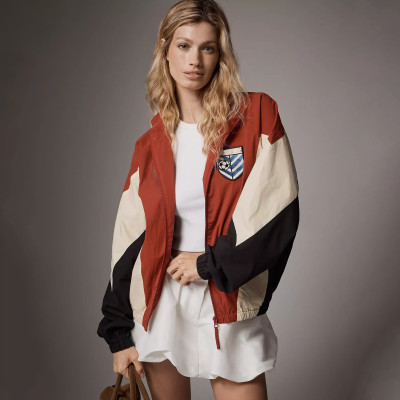
Private Label vs Custom Manufacturing: Which Is Right for Your Brand?
Private Label vs Custom Manufacturing: Which Is Right for Your Brand?
When you are ready to launch or expand an activewear line, the first fork in the road is usually this: Do you private-label an existing product, or do you build something from scratch? One gets you to market faster. The other gives you a product nobody else can copy. Neither is universally better. The right choice depends on where your brand is today, how much control you need, and how much budget and time you can commit.
In this guide, we will look at both models side by side so you can walk into a factory conversation knowing exactly what to ask for.
What private label means in activewear
Private label means you choose an existing garment from a factory's catalog—think a standard sports bra, a pair of leggings, or a tank top—and have it produced under your own brand label. You can usually customize colors, add your logo, tweak small details like label placement or packaging, and sometimes select from a menu of available fabrics.
The core design, pattern, and construction remain the factory's. You are essentially renting their ready-made product and branding it as your own.

What custom manufacturing means
Custom manufacturing means the product starts with your idea. You provide a tech pack, reference samples, sketches, or a detailed brief. The factory creates patterns, sources fabrics, makes samples, and produces the final run based on your specifications. Every stitch, seam, fabric, and trim is selected to match your vision.
This is the path brands take when differentiation is the whole point: a unique cut, proprietary fabric, special construction, or a feature set that cannot be bought off the shelf.
Side-by-side comparison
| Factor | Private Label | Custom Manufacturing |
|---|---|---|
| Design control | Limited to color, logo, labels, minor tweaks | Full control over pattern, fabric, trims, construction |
| Minimum order quantity | Lower, often hundreds per style | Higher, often thousands per style after sampling |
| Development time | Faster, weeks rather than months | Longer, due to pattern and sample development |
| Upfront investment | Lower sampling and tooling cost | Higher sampling, pattern, and development cost |
| Product differentiation | Low—others may sell the same base style | High—you own the unique design |
| Best for | Testing a new market or brand launch | Building a defensible, signature product line |
Private label works best when...
- You are validating a new market and need inventory fast.
- Your budget is tight and you want to avoid heavy sampling costs.
- You are building a brand around marketing, community, or distribution rather than product innovation.
- You need a reliable, repeatable style with predictable lead times.
Custom manufacturing wins when...
- You have a clear design concept that existing styles cannot deliver.
- Fabric performance, fit, or construction is your competitive edge.
- You are positioning as a premium or technical activewear brand.
- You plan to wholesale and want products retailers cannot find elsewhere.
A real-world example
Consider a new yoga brand entering a crowded market. They launch with private-label leggings and a sports bra in three colors. Sales prove there is demand. Six months later, they move to custom manufacturing for a second collection: a high-waist legging with a hidden pocket, a reinforced gusset, and a branded waistband construction. The first phase reduced risk. The second phase built defensibility.

Five questions to help you decide
- Do I already know exactly what I want to build? If the design is vague, private label gets you started faster. If it is precise, custom manufacturing is worth the wait.
- Is my budget more limited than my time? Private label costs less upfront. Custom manufacturing costs more before you sell a single unit.
- Is differentiation critical to my brand? If yes, custom is the only route that protects your idea.
- What MOQ can I realistically sell? There is no point in custom development if you cannot move the minimum production run.
- Do I have the internal skills to manage development? Custom manufacturing requires tech packs, sample feedback, and fit revisions. Private label is simpler to manage.
Common questions
Can I start private label and switch to custom later?
Yes. Many brands use private label to test demand and fund a later custom collection. Just make sure your factory can support both paths so you do not have to start supplier relationships from scratch.
Who owns the design in custom manufacturing?
You should. Before you start, confirm in writing that patterns, tech packs, and any custom-developed fabrics belong to your brand. This is standard in OEM arrangements but always worth clarifying.
Is private label lower quality?
Not necessarily. Quality depends on the factory and the base product. The difference is control, not automatically inferior workmanship.
Choosing between private label and custom manufacturing is not about which option is better on paper. It is about which option matches your brand stage, budget, and ambition. If you are unsure, send us a brief and we can review your goals, recommend the right path, and show you where each model fits into a realistic production plan.